
How To Meet People At Festivals After 35
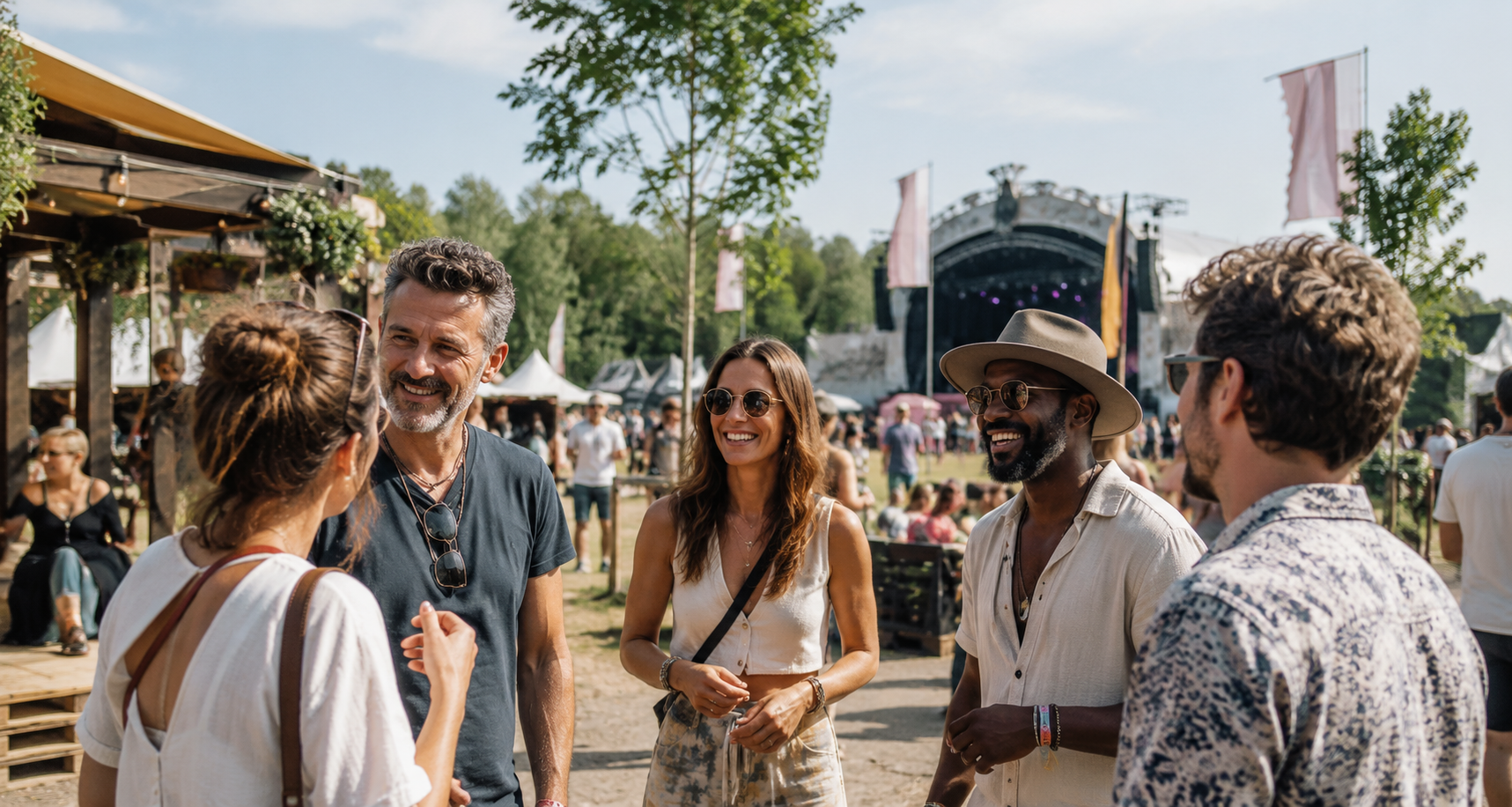
There is a particular kind of loneliness that can creep in at a festival when you are older than most of the crowd. You have arrived with the right boots, the right hotel, even the right expectations — and yet you find yourself standing at the edge of a stage, a drink in hand, watching everyone else seem to know each other already.
It is not that you have forgotten how to connect. It is that the old mechanics no longer feel natural. The shouty introduction over the bass line. The shared cigarette. The easy, frictionless camaraderie of your twenties, when proximity was enough. After 35, socialising at festivals requires a different kind of intention — and, frankly, a little more strategy.
The good news: it is entirely possible. More than possible. Festivals, at their core, are still one of the most connective social environments on earth. You just need to know where to look, and how to approach it.
Why It Feels Harder After 35 (And Why That's Actually Fine)
First, let's name the thing. After 35, most of us have built a life structured around familiar people — partners, long-term friends, colleagues. The muscle for meeting strangers in high-stimulus environments gets used less. Add to that a lower tolerance for chaos, a preference for quality over quantity in social interactions, and a natural wariness of performing enthusiasm you don't feel — and you have a cocktail that can make festival socialising feel surprisingly effortful.
But here is the reframe: the very things that make it harder also make you better at it.
You are not looking to impress. You are not performing. You know what you actually like, and you can talk about it with genuine conviction. At 38 or 45 or 52, a five-minute conversation with the right person is worth infinitely more than two hours of surface-level noise. That is not a disadvantage. That is a different — and often richer — kind of social experience.
The goal is not to replicate the social free-for-all of your festival twenties. The goal is to find your people, in fewer attempts, with more ease.
Step 1: Choose the Right Festival
This is where it starts, and it matters more than most people acknowledge. Not every festival is designed for the kind of socialising that works well after 35.
Look for festivals with a genuine community identity — ones where the audience has something in common beyond age. Bluedot attracts scientists and creatives. End of the Road draws literary types. Montreux Jazz Festival self-selects for people who take music seriously. Primavera Sound has a notably discerning crowd. These are not incidental details. They are social architecture.
When the crowd shares a sensibility, conversation starts itself. You do not need an opening line. You need a lineup.
Practical tip: read a festival's editorial coverage, not just its website. The publications that cover it, the brands that sponsor it, the language used in its own communications — all of this tells you who actually goes.
[AFFILIATE: GetYourGuide — curated festival experiences and guided local tours near major festival destinations]
Step 2: Go With Fewer People, or Alone
This may feel counterintuitive. But arriving at a festival as part of a large, closed group is one of the most effective ways to not meet anyone new.
Groups create their own gravity. They face inward. They fill the silences that would otherwise be openings. A pair or a solo traveller is far more socially available — and is perceived as such by others.
Going alone to a festival after 35 is, increasingly, a conscious and respected choice. The solo festival traveller has become their own archetype. There is nothing to explain or apologise for. If anything, it signals confidence and independence — two qualities that attract interesting people.
If you are not ready to go fully solo, consider going as a pair with a friend who is equally open to meeting others, and who will not require constant group management.
Step 3: Use the Quiet Moments
The loudest parts of a festival are, paradoxically, the hardest places to meet people. The real connections happen in the margins.
The queue for coffee at 9am. The shaded area between stages at 2pm. The artisan food stalls where people linger rather than rush. The smaller, seated stage where the crowd is calmer. The charging point tent, where everyone is stationary and vaguely bored.
These are the environments where conversation happens naturally. Nobody is performing. Nobody is mid-way through a mosh pit. A simple, genuine observation about the coffee, the set, the heat, the lineup — these are all the entry points you need.
After 35, you are good at this kind of conversation. You have been having it at dinner parties and work events and airport lounges for years. A festival is just a different venue.
Step 4: Be a Regular at One or Two Spots
Rather than moving constantly through the site, find one or two places where you genuinely want to spend time and return to them.
This is how the best festival friendships form — not through a single encounter, but through repeated proximity. The same bar, the same afternoon stage, the same food vendor. You start to recognise faces. Faces start to recognise you. A nod becomes a hello. A hello becomes a conversation.
This is the social logic of neighbourhood life applied to festival grounds. It works.
Step 5: Talk About the Music
This sounds obvious, and it is — but it is also underused. Music is the shared language at every festival, and it provides the easiest, most genuine entry point to a real conversation.
Not "what do you think of the lineup?" (too vague, too easy to answer in one word). But something specific. "Did you catch the second act on the smaller stage this morning? That was genuinely unexpected." Or: "I have been following this artist for years — I cannot quite believe I am finally seeing them live."
Specificity signals taste. Taste attracts people with taste. After 35, you have enough of both to use them.
Step 6: Use Structured Social Opportunities
Many festivals now offer programming that functions as social infrastructure — workshop tents, guided walks, yoga sessions, panel talks, documentary screenings. These are not the main event. But they are remarkably effective environments for meeting people.
A shared experience with a clear beginning and end creates an automatic conversational framework. You went through something together. You can talk about it afterwards. The social barrier is essentially removed.
Look for these in the programme and treat them as intentional social investments, not just filler between headliners.
[AFFILIATE: GetYourGuide — yoga retreats, wellness workshops and cultural experiences bookable around festival weekends]
Step 7: Stay in Boutique or Shared Accommodation
Where you sleep has a significant effect on your social experience.
A private tent in a remote camping area offers almost no organic socialising. A boutique hotel in town offers slightly more, but still requires effort. The highest-density social environments for festival travellers after 35 are boutique guesthouses, small festival hotels, or curated glamping setups with communal areas.
[AFFILIATE: Mr & Mrs Smith — boutique and design hotels near major festival destinations — ?ref=FESTIVORA]
[AFFILIATE: Booking.com — guesthouses and small hotels with communal breakfast areas near festival locations — ?aid=FESTIVORA]
Breakfast is the secret weapon. A shared table over good coffee is one of the most natural social environments that exists. It is quiet, it is slow, and the conversation is easy. The people around you have the same interests (they are at the festival), the same rough demographic, and the same desire for a civilised morning. It practically organises itself.
If you are booking accommodation for a festival trip with social connection in mind, prioritise properties with a communal breakfast or lounge area over those that offer pure privacy.
Common Mistakes to Avoid
Waiting to feel ready. The readiness does not arrive before the conversation. It arrives about thirty seconds into it. Start anyway.
Staying too close to your phone. A phone in hand is a "do not disturb" sign. Pocket it. Look up. The social world of a festival is entirely analogue.
Dismissing brief encounters. Not every conversation leads to an email address or a friendship. But a meaningful five-minute exchange with a stranger about a piece of music you both love is not nothing. It is, in fact, one of the things festivals are for.
Expecting it to feel effortless. It might not. That is fine. The slight awkwardness of an opening exchange is not a sign that you are doing it wrong. It is just the first thirty seconds of every conversation that was ever worth having.
Over-relying on your existing group. If you are travelling with friends, give yourself permission to wander alone for a few hours. This is not antisocial. It is the condition under which new connections form.
Expert Tips
Wear something that invites comment. A distinctive hat, a considered outfit, a badge from a previous festival edition — anything that gives a stranger an easy opening. This is not vanity. It is social architecture.
[AFFILIATE: Amazon — festival outfit essentials and accessories for the over-35 festival traveller]
Learn two or three names in the lineup in depth. Not just that you like them — but something about their history, their influences, their catalogue. Depth of knowledge is attractive in conversation. It signals that you are someone worth talking to.
Eat at the sit-down food areas. Not the grab-and-go stalls. Find the places where people sit with their plates and linger. These are micro-communities. Join them.
Follow up. If you meet someone interesting and exchange details, send the message. This is where many potential festival friendships simply dissolve — into good intentions that never become actions. Send the message within 48 hours.
FAQ
Is it weird to go to a festival alone after 35?
No. It is increasingly common, and widely respected within festival communities. Solo travellers are often the most interesting people at any festival, for the simple reason that they have had to develop social confidence as a practical skill.
How do I start a conversation without it feeling forced?
The easiest route is specificity about the shared context. A genuine, specific observation about the music, the food, the setting — something you actually noticed and actually thought — is always better than a generic opener.
What if I am naturally introverted?
Introversion and social connection are not mutually exclusive. Introverts often prefer the kind of deeper, one-to-one conversations that festivals, in their quieter moments, provide in abundance. Find the lower-stimulus environments on site and work from there.
Do festival apps or social features help?
Some festivals now have official apps with social features or community boards. Worth using, not as a substitute for in-person interaction, but as a warm-up. Knowing that someone else on the app is also looking forward to a particular act gives you a natural opening if you encounter them.
What if I simply do not click with anyone?
Then you had a festival experience that was rich in music, food, and your own company — which is not a failure. Connection is the bonus, not the baseline.
Conclusion
Meeting people at festivals after 35 is less about technique and more about orientation. It requires a quiet decision to be open, a willingness to sit in the slight discomfort of a new conversation, and a trust that the people who are right for you to meet are very likely already there, standing in the same queue for the same set, waiting for someone to say something real.
The mechanics are simple. The coffee queue. The quiet stage. The shared table at breakfast. The specific, honest observation about a song you both love.
You do not need to be younger, louder, or different to any version of yourself. You just need to show up with some intention — and let the festival do the rest.
