
What Awakenings Gets Right About Festival Travel
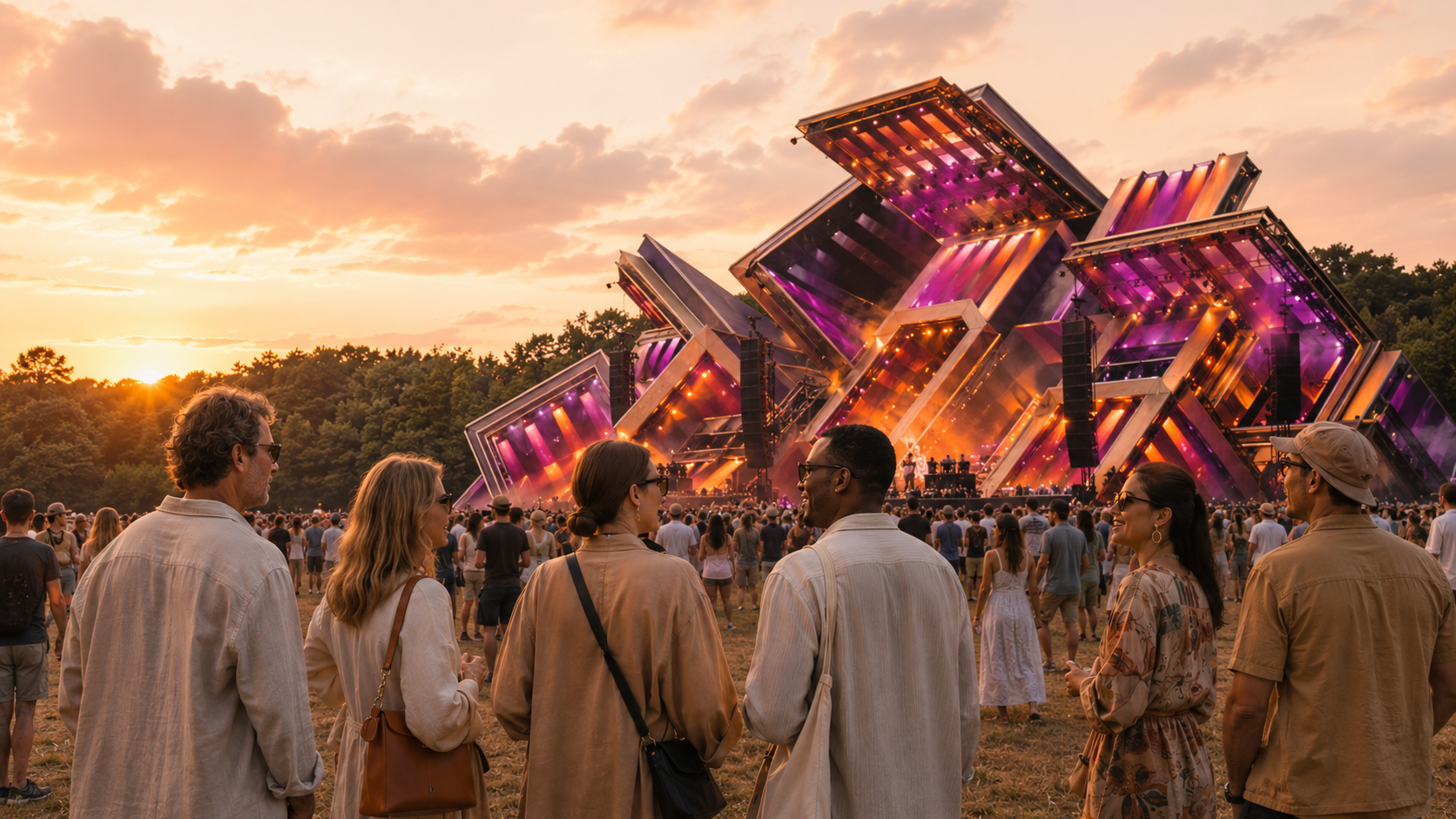
At a moment when festivals across Europe are quietly folding — announcing cancellations, citing rising costs, shrinking crowds, a post-pandemic hangover that simply will not pass — Awakenings sold out again. Not slowly. Not with discounts. Without much fanfare at all, really.
The 2026 edition at Hilvarenbeek sold out completely. Not a single ticket left.
For those who have been attending for years, this comes as no surprise. But for anyone watching the broader festival landscape, it raises a question worth sitting with: what exactly is Awakenings doing that so many others are not?
The answer, we think, has very little to do with music.
Or rather, it has everything to do with music — but not in the way most people assume. The programme is, of course, exceptional. The names on the bill are precisely the names serious techno listeners want to see. But you do not sell out a major festival year after year by booking good DJs. You do it by building something that people want to travel towards. Something that feels, from the moment you start planning your route to Noord-Brabant, like the beginning of a proper journey.
That is where Awakenings has quietly, consistently excelled.
A Festival That Feels International
There is a particular kind of festival that manages to transcend its geography. Awakenings is, on paper, a Dutch festival. It takes place in the Netherlands, is rooted in Amsterdam's club culture, and has spent nearly three decades building its reputation within that context. And yet, stand near the entrance on a Saturday morning and you will hear French, German, Spanish, Swedish, Polish, Italian. You will see group chats being coordinated in a dozen languages.
This is not accidental. Awakenings built its reputation by taking the global techno community seriously — booking artists who carry genuine weight internationally, maintaining a curatorial standard that did not waver when trends shifted. In doing so, it became a destination rather than an event. People do not simply attend Awakenings. They fly to it, take trains across borders for it, plan their summer around it.
For the festival traveller aged 35 and over, this matters enormously. The willingness to travel for a festival implies a willingness to invest — financially, logistically, emotionally. You are committing time, money and energy. You want to know, before you book, that the thing you are travelling towards has earned that kind of attention. Awakenings has.
More Than Music: The Complete Weekend Experience
A festival that sells out consistently is one that people talk about between editions. They talk about it at dinner in February. They send voice messages about it in March. By the time tickets go on sale, the decision has already been made — not because of the line-up announcement, but because of everything that happened the last time.
Awakenings understands that the experience extends far beyond the festival gates. The Summer edition at Beekse Bergen sits within a natural landscape of woodland and open water in the heart of Noord-Brabant that lends itself to something far more expansive than a single-day trip. People arrive the night before. They base themselves in Tilburg — a city that rewards an extra night far more than most people expect — take the shuttle bus in on Friday morning, and approach the weekend with the kind of calm intentionality that makes festival-going genuinely enjoyable rather than exhausting.
Those who prefer to stay closer to the music choose from three on-site camping options: The Grand Camping for the full immersive experience, The Comfort Camping for a more considered setup, or The Relax Resort for those who would rather not spend three nights in a sleeping bag. For a boutique stay in Tilburg itself, Mr & Mrs Smith is worth checking before you book.
There is a ritual quality to how many attendees now structure their Awakenings weekend — the same campsite neighbours returning year after year, the Sunday shuttle back to Tilburg station, the particular satisfaction of three days very well spent. That ritual is as much a part of the festival as the music itself.
Production Quality People Can Trust
Trust is underrated in the festival world. It is also, increasingly, the thing that separates the events that endure from those that quietly disappear.
After years of attending festivals, you develop a sixth sense for the ones that are run with genuine care. The signs are everywhere: whether the sound system is properly tuned before the first act starts, whether the site layout makes logical sense, whether the toilets are maintained throughout the weekend rather than abandoned to entropy by Saturday evening, whether the stages begin and end on time.
Awakenings is meticulous on all of these fronts. The production quality is, and has been for many years, at the upper end of what electronic music festivals offer. The stage designs are architectural propositions in their own right. The sound is calibrated with an attention to low-end that rewards a discerning listener. The organisation is precise without being sterile.
For a first-time visitor, this professionalism reads as impressive. For a returning visitor, it reads as trustworthy. And trust, once established and consistently honoured, is the most powerful retention mechanism a festival can have.
Why It Resonates With Festival Travellers Over 35
There is a version of festival culture that optimises for excess — maximum stimulation, minimum rest, the performance of abandonment. That version of things tends to appeal to a particular age bracket, and it tends to appeal to that bracket for a finite number of years.
What Awakenings offers is something different: intensity that rewards attention. The music is not incidental noise; it is the reason you are there. The crowd reflects this. Conversations between sets are about the music. People are listening rather than simply being present.
For the festival traveller in their late thirties or forties, this environment feels like a return to first principles. You came for the music. The music is excellent. The surroundings support rather than undermine the experience. You sleep in an actual bed or a well-organised campsite. You eat a real meal the night before. You approach the weekend from a position of reasonable comfort, which means you are present and engaged rather than depleted and reactive.
This is not about ageing out of festival culture. It is about growing into a more intentional version of it. If you are arriving a day early — which we always recommend — GetYourGuide's Tilburg edit offers a good starting point for the city's food scene, design culture and the Beekse Bergen nature reserve itself.
Community as a Long-Term Asset
Every festival claims community. Few have built one in any meaningful sense.
Awakenings is, genuinely, one of the exceptions. The community around it is international, musically literate, and remarkably consistent over time. The same faces reappear. Friendships formed at the festival extend into the rest of the year. Group chats from previous editions reconvene when the line-up drops. There are people who have attended every edition for a decade or more, who regard it less as an event and more as a point of return.
This kind of loyalty is not manufactured through loyalty schemes or social media campaigns. It grows from the experience itself — from the sense that the festival takes its audience seriously, that it has built something worth returning to, that the people around you share a genuine investment in the music and in the event.
For festival organisers watching from the outside, this is perhaps the most instructive element of what Awakenings has built. The community is not a marketing asset; it is a consequence of consistently delivering something that deserves loyalty. The order of operations matters.
What Other Festivals Can Learn
The festival industry is not short of advice — panels are devoted to it, consultancies built around it. But the lessons from Awakenings are, at their core, fairly simple.
Curate with genuine conviction rather than for broadest possible appeal. Maintain production standards even when it is expensive to do so. Design the experience around the complete weekend rather than around the stage programme alone. Trust that an audience with high standards will return if those standards are consistently met.
There is also something instructive in what Awakenings has largely avoided: the temptation to expand too aggressively, to franchise the brand across multiple territories before the foundation is secure, to chase short-term ticket volume at the expense of long-term reputation. Restraint, in festival building as in most things, tends to compound.
For the festival traveller, this translates into a simple heuristic: the festivals worth travelling towards are the ones that have spent years building something before asking you to invest your weekend in it. Awakenings has been doing exactly that since 1997. Next year it celebrates thirty.
Conclusion
Awakenings continues to sell out not because it is the loudest or the largest or the most aggressively marketed festival in Europe. It continues to sell out because it has, over nearly three decades and with considerable consistency, earned the trust of a global audience that knows what it wants.
That audience wants music that is worth listening to. It wants a production that has been thought through. It wants a weekend that begins the moment you board the train to Tilburg and does not really end until you are home on Sunday evening, headphones in, already thinking about next year.
That is what great festival travel feels like. Awakenings delivers it reliably, and in doing so, it offers a model that the rest of the industry would do well to study carefully.
