
What to Wear to a Festival After 35
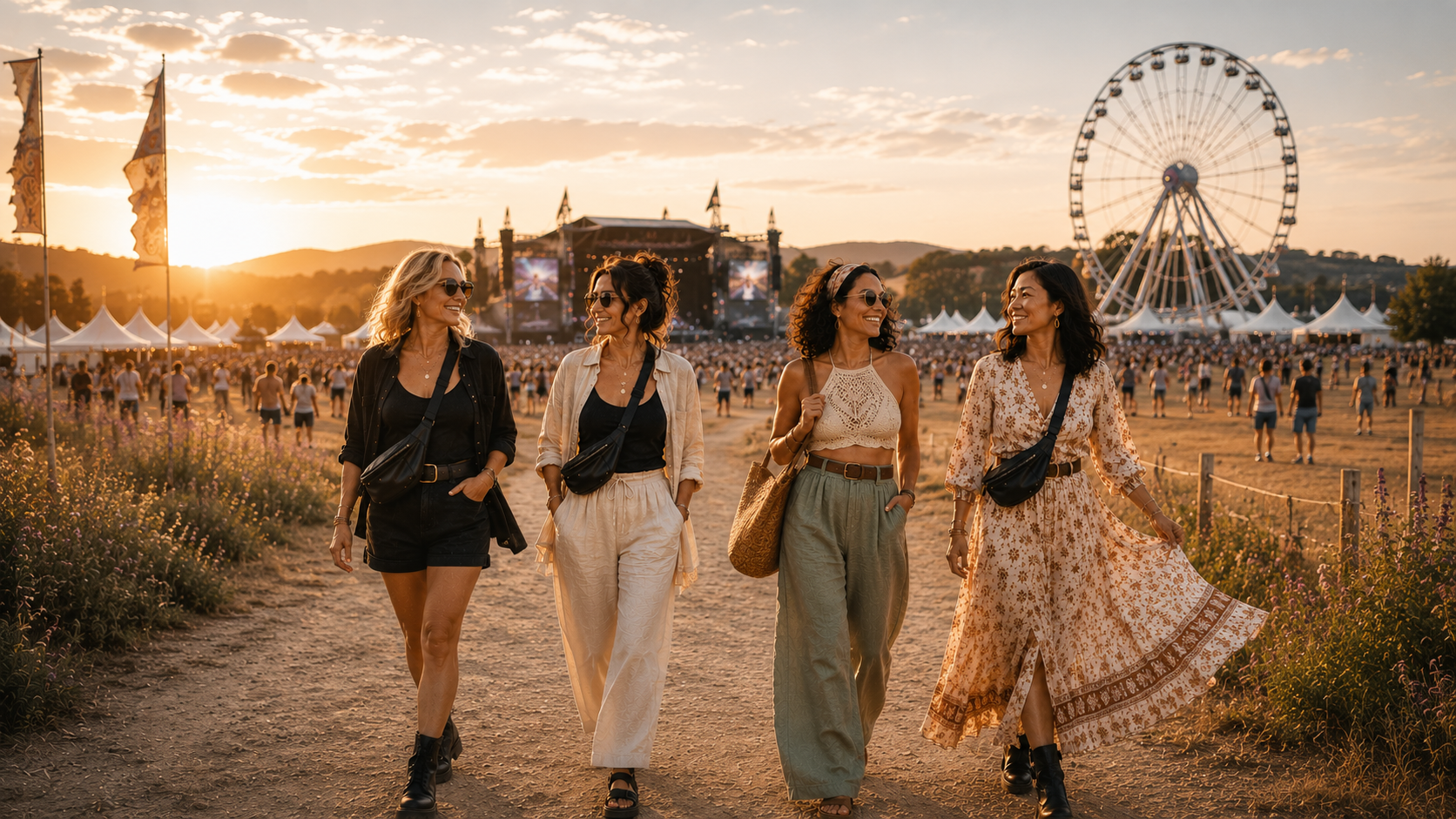
There comes a point, somewhere around your mid-thirties, when the question of what to wear to a festival stops being about trend-chasing and starts being about something more considered. You still want to look like yourself. You still want to feel the music, the heat, the moment. But you also want to walk eight hours without regretting your footwear, stay warm when the temperature drops after midnight, and not spend Sunday morning picking glitter out of a wound.
This is not a failure of imagination. It is, in fact, the beginning of better dressing.
Festival fashion after 35 is not about dressing younger. It is about dressing smarter — with a clarity about who you are and what you actually need from a weekend in a field. The result, when you get it right, is effortless in a way that no amount of sequinned co-ords can manufacture.
This guide will walk you through exactly how to build a festival wardrobe that works: practically, aesthetically, and for the kind of festival experience you actually want to have.
The Real Problem: Dressing for Two Versions of Yourself
The central tension in festival dressing after 35 is this: you are not just dressing for the afternoon. You are dressing for the person who wants to feel alive at the mainstage at 11pm and the person who wants a quiet coffee at 8am without looking like a casualty. You are dressing for heat, cold, dust, rain, dancing, sitting on the ground, and occasionally, dinner somewhere that requires a little more intention.
Most festival packing advice ignores this. It assumes you are twenty-three, unbothered by blisters, and sleeping in a tent with a sleeping bag that cost fourteen pounds. It recommends things like "mesh tops" and "bucket hats" without acknowledging that you may prefer linen, that your lower back exists, or that you have spent enough years in uncomfortable shoes to know better.
What follows is advice for the version of you that exists now — informed by experience, clear about preferences, and unwilling to sacrifice three days of physical comfort for the sake of a look that doesn't even feel like yours.
Step One: Build Around a Colour Palette, Not a Trend
The single most effective thing you can do before packing anything is to choose a palette of three to four colours that work together. This is not a styling trick — it is a logistics strategy. When everything coordinates, you can pull any combination of pieces out of your bag and have an outfit. You are not relying on having the right top with the right bottom on the right day.
For festival environments, palettes that tend to work well include warm neutrals (sand, terracotta, camel, warm white), tonal darks (charcoal, olive, deep navy, black), or a base of neutrals with one accent — dusty rose, rust, sage. These tones tend to survive both full sun and low light beautifully. They also tend to survive dust.
Avoid building a festival wardrobe around white. It is an aspiration that the festival will immediately and decisively defeat.
Step Two: The Foundation Pieces
Every day of a festival is built on the same four foundation pieces. Get these right and everything else becomes detail.
Trousers or a skirt that can walk
Wide-leg linen trousers remain the single best festival bottom for anyone over 35. They are cool in heat, they move well when dancing, they look considered without trying, and they do not leave marks on your skin after hours of sitting or standing. Brands such as Arket, COS, and & Other Stories produce versions that travel without creasing catastrophically. If you prefer a skirt, a midi-length in a fluid fabric works on the same logic — movement, breathability, and the kind of quiet elegance that photographs well without being constructed around being photographed.
Denim is not wrong, but it is a commitment. If the temperature rises, you will feel it. If you get wet, you will feel that too.
A top that works for both day and night
The ideal festival top after 35 is one that works in the afternoon heat and doesn't require a full costume change by evening. A lightweight silk or satin cami in a neutral layered under an open linen overshirt covers both scenarios. The overshirt comes off in the afternoon; it goes back on when the temperature drops. Add a jacket later if needed.
Footwear that is non-negotiable
This is the category where experience matters most, and where most people — regardless of age — still make the wrong call. Festival footwear must do three things: support your feet across long hours on varied terrain, be easy to get on and off, and not require breaking in at the event itself.
The options that consistently deliver: chunky sandals with ankle support (Birkenstock, Teva, or equivalent), short Chelsea boots in leather or suede (wipe-clean and protective), or clean trainers in a low-profile silhouette. All three can look deliberate rather than functional. The key is that they must have been worn before. A festival is not a trial run.
A layer that travels
Temperatures at outdoor festivals rarely stay stable across a full day. A lightweight layer that compresses small enough to live in your bag is essential. The best options are a fine-knit merino cardigan, a structured overshirt, or a packable quilted vest. Merino is worth noting separately: it regulates temperature, resists odour, and does not feel like sportswear. For multi-day festivals, it is close to indispensable.
Step Three: The Bag Situation
Your bag determines how you move through the day. Get this wrong and everything else is harder.
The combination that works best for most festival scenarios after 35 is a small crossbody or belt bag for daytime essentials (phone, card, sunscreen, lip balm, small water bottle) combined with a packable tote that lives in your hotel bag or tent until you need it. The crossbody keeps your hands free and your valuables close. The tote handles any overflow.
Backpacks are practical but tend to make an outfit read more utilitarian than necessary. If you prefer a backpack, a leather or canvas option in a minimal silhouette keeps the aesthetic more intentional.
Avoid anything with multiple open pockets, anything that can't be closed securely, and anything with a long strap that swings when you dance.
Step Four: The Evening Shift
One of the great pleasures of festival life after 35 is the evening — when the crowd has thinned slightly, the light has gone golden, and the headliner is about to come on. How you dress for this moment matters.
The evening shift does not require a full outfit change. It requires one or two pieces that shift the register: a leather or faux-leather jacket that elevates whatever you are wearing underneath, a pair of earrings that feel more considered than your daytime choices, or a scarf worn loosely over the shoulders that doubles as warmth.
The jacket is the single most effective evening upgrade. A simple black or tan leather jacket works over linen, over a cami, over a shirt. It says something without trying to say too much.
Editor's Pick
Birkenstock Boston on your feet. A merino crewneck in camel. One leather belt bag, worn across the body. A pair of oversized gold hoops for the evening shift. And a linen overshirt that works from the first afternoon set to the last song of the night. These are the five pieces we would actually pack.
The Mistakes Most People Make
Wearing something new
This cannot be overstated. New shoes, new trousers, a new bag that hasn't been broken in — all of these are ways of ensuring you spend at least part of the festival thinking about your outfit instead of the music. Everything you bring should have been worn and tested before you leave.
Over-packing for variety, under-packing for comfort
The instinct to have a different look for every day leads to bags that are too heavy and choices that are too complicated. Three days of a festival need fewer outfits than you think. What they need is the right layers, repeated in different combinations.
Neglecting the basics in favour of the statement
A striking hat or a bold accessory is not useful if you are wearing it over a top that isn't the right temperature or shoes that are failing you by 3pm. Build the foundation first.
Forgetting rain
In Europe, outdoor festivals in June, July, and August are not guaranteed to be dry. A compact rain poncho takes up almost no space and costs very little. It is the piece you will be most grateful for if you need it and most relieved not to have needed if you don't.
Underestimating accessories
Sunglasses, a lightweight scarf, a well-chosen hat — these are the pieces that make an outfit read as considered rather than assembled. They are also the pieces that offer practical protection from sun, from cold, and from the kind of eye contact you sometimes want to avoid in a large crowd.
Expert Tips
Pack everything into a single colour family before you leave home. If it doesn't coordinate with everything else in the pile, it doesn't come.
Natural fibres — linen, cotton, merino, silk — perform better across a full festival day than synthetic alternatives in almost every condition. They breathe, they regulate temperature, and most of them can be rinsed in a hotel sink and dried overnight.
Keep one going-out piece in reserve — something you haven't worn yet on the final night. Arriving at a closing set in something that still feels fresh is a small and satisfying luxury.
Bring a compact, refillable fragrance. The act of applying it before an evening set is a reset that costs nothing and changes everything.
If you are staying in a hotel rather than camping, use the hotel room as your dressing room. Leave the bag light during the day and return to freshen up before the evening programme.
Frequently Asked Questions
Is it possible to look stylish at a festival after 35 without looking like you're trying too hard?
Yes — and in fact, this is the advantage of dressing with more experience behind you. Style after 35 tends to be quieter, more personal, and more legible than the trend-driven looks of a younger crowd. The key is to dress like yourself, not like a version of yourself that is trying to fit a festival aesthetic. The most stylish people at any festival are invariably the ones who look like they dressed without consulting anyone.
What about festival glitter, face gems, or statement accessories?
There is nothing wrong with a considered embellishment — a single face gem, a vintage silk scarf worn in an unexpected way. What tends to age poorly is commitment to a full costume. Wear what you would actually enjoy wearing, not what you think a festival demands.
What footwear works for camping festivals versus hotel-based ones?
For camping festivals, closed-toe footwear with grip — a chunky sandal, a low boot — is more practical than open sandals, particularly after rain. For hotel-based festivals, you have more latitude. A clean white trainer or a leather sandal with support works well when you are not navigating uneven, potentially muddy ground.
How do I keep clothes fresh across a multi-day festival?
Natural fibres are your best ally here. A merino layer worn across multiple days will not carry odour the way synthetic fabric does. A small travel-size laundry sheet or detergent pod allows you to rinse key pieces in a hotel sink overnight. A light fragrance spray on fabrics in the morning extends freshness through the day.
What should I pack for an unexpected cold night?
A packable down gilet or quilted vest is the most effective single piece for unexpected cold. It adds significant warmth without adding bulk or changing the visual register of your outfit. Worn under a jacket, it extends warmth considerably further than either piece alone.
Conclusion
Festival dressing after 35 is not a compromise. It is, if anything, a refinement. You are no longer dressing to perform a version of festival identity that doesn't quite fit — you are dressing for the experience you actually want to have, on a body you actually live in, with an aesthetic that is genuinely your own.
The wardrobe that serves you best is built on foundation pieces in a coherent palette, chosen for comfort and movement, layered for temperature change, and finished with one or two pieces that shift the evening register. It travels light, coordinates without effort, and leaves room for the things that actually matter: the music, the people, the moment.
Pack less than you think you need. Choose better. Arrive ready.
Related reading on &Festivora:
